
Vibe-Coding is Resurrecting the Feature Factory
The friction that used to protect us from building the wrong things is disappearing. With vibe-coding, "Yes" is too easy. This is the new "Zero-Marginal-Cost Feature Trap."

There is a specific kind of euphoria that comes with “vibe-coding.” Last weekend, I sat down with a new idea for an app. Usually, this would involve weeks of scoping, trade-offs, and technical hurdles. Instead, using a vibe-coding tool, I built the whole thing in a day. By Saturday evening, the core logic was live. By Sunday morning, I wasn’t just testing; I was expanding. Since it took so little effort to add a “nice-to-have” feature, I started adding several more.
Then, I stopped.
I realized I had fallen straight into a rabbit hole. Just because it was easy to build new features; just because it was fast. And probably because of the dopamine-inducing effect of vibe-coding: it’s exciting to give instructions and to see your idea come to life a few seconds later. You just want to keep going. And without realizing it, you have built much more than what was needed.
Yes, it’s easy and fast. But it doesn’t mean it’s right: This is the old PM conundrum, resurfacing under a new AI disguise.
It’s what Melissa Perri calls the Build Trap. As she famously noted, many organizations measure success by outputs rather than outcomes. They focus on production volume rather than value. We often get stuck in a cycle of shipping features because it makes us feel productive, regardless of whether those features actually move the needle for the user.
Vibe-coding has effectively removed the friction of production. When the cost of building a feature drops to near zero, the natural human instinct is to build everything. While AI has solved the delivery bottleneck, it has inadvertently resurrected our oldest enemy: The Feature Factory.
The Return of the Feature Factory
For years, we trained PMs to focus on outcomes and to use the most important PM word: “No”. This helped shift the mindset from volume production to ruthless prioritization.
The high cost of engineering acted as a natural filter for bad ideas. Product Managers had to be disciplined because developer time was the most expensive resource in the building. If you wanted a feature, you had to prove its value. From output to outcomes.
Now, that guardrail is gone. Vibe-coding creates a “Zero-Marginal-Cost Trap”. We start padding products with unvalidated ideas because “it only takes a minute.” When it’s easy and fast to build new things, the PM word is replaced by “Why not?”
The problem is that even if a feature takes zero minutes to build, it is never free. Every button you add increases the cognitive load for your user. Every extra screen makes it harder to run a clean A/B test because you’ve introduced too many variables.
Even if it took 48 hours instead of 4 months, it’s still time wasted if it doesn’t solve the core user problem. When you launch a “complete” product built over a weekend instead of a stripped-back MVP, you lose the ability to see which specific part of the value proposition actually resonates. You aren’t just building a product; you are building noise.
Shadow Tech Debt and the Attention Tax
There is a more insidious risk lurking in AI-generated code: Shadow Tech Debt. When we vibe-code, we often prioritize the “vibe” (the functional output) over the underlying architecture. We are creating segments of code that we might not fully understand or that become “ghost features” when we inevitably pivot. This leads to a brittle architecture that is incredibly difficult to roll back or change later. If you don’t know why the AI wrote a specific function, you won’t know how to fix it when it breaks under the weight of your tenth “easy” feature.
Furthermore, we must account for the Opportunity Cost of Attention. Even if the AI builds a feature for you, you still have to manage it. You have to support it, explain it to stakeholders, and fix bugs in it. You need to test it with your users Every unvalidated feature you add is a tax on your future mental energy.
In addition, building too much into your product introduces Validation Noise: It’s harder to tell what’s working when you launch a “complete” product instead of an MVP.
The Antidote: The Product Journey Map
To resist the rabbit hole of Product Padding to Perfection, you need a tool that enforces focus. Most PMs rely on roadmaps, but roadmaps are primarily for stakeholder management. They communicate a plan and a timeline, and do not help you make the hard daily decisions about what not to build. Roadmaps imply that decisions on the products have already been made, often projecting these decisions weeks or months out in the future.
But the problem is not stakeholder communication. It’s critical decision-making on what matters and what does not.
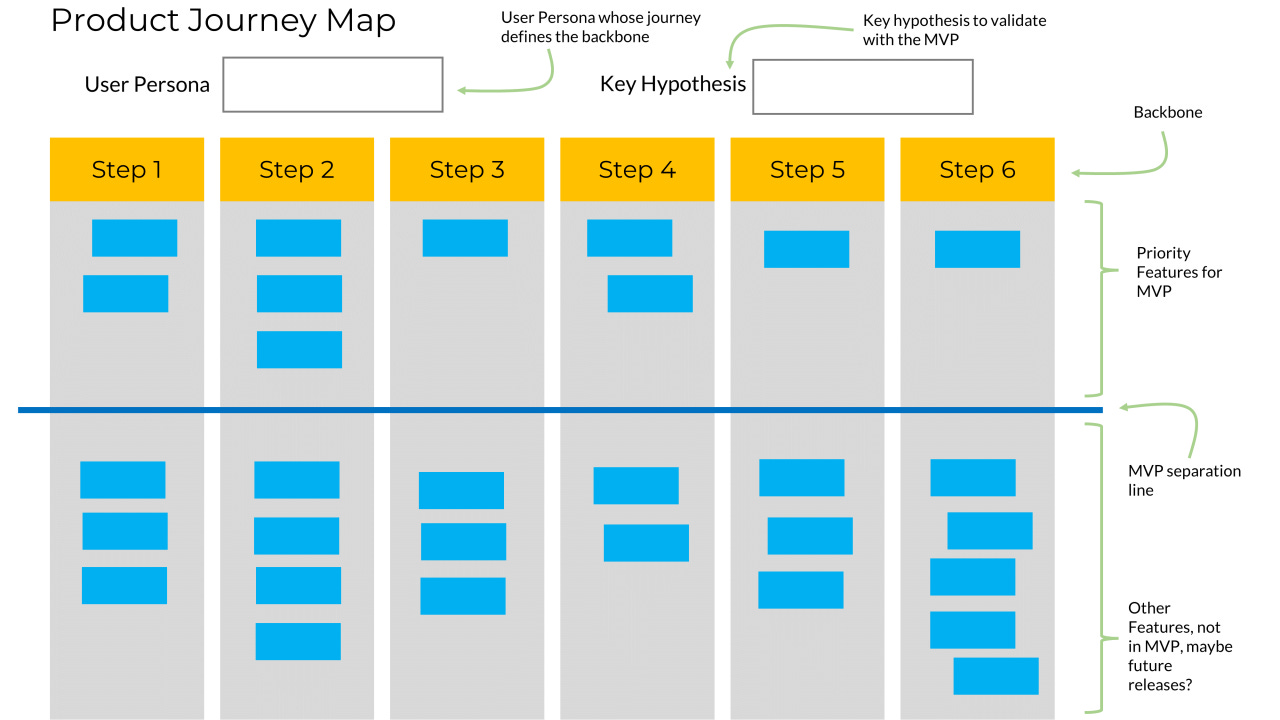
This is where the Product Journey Map becomes essential. Unlike a roadmap, the Product Journey Map is a decision-making framework. It forces you to map every potential feature to a specific milestone in the user’s experience. It forces you to think if you really need that feature right now, or if it can wait. It helps you to focus on the core features that are needed to test and validate your core hypotheses, rather than padding the product with “nice-to-haves”.
When I was building my app over the weekend, I used a Product Journey Map to create a plan for my product. I mapped out the steps in my user’s journey, and then I listed the features for each step. I drew a “blue line”, dividing my core MVP features from the “nice-to-haves”. And then I stopped vibe-coding once the user could achieve the primary “Aha! Moment”.
No more vibe-coded dopamine. Time for user validation.
By using a Journey Map, you can visualize exactly where a feature sits. If a feature doesn’t directly help the user move from one stage of their journey to the next, it is a distraction or a future extension. If it doesn’t help you test your core hypotheses, move it below the blue line. You can always add that feature later.
The overall lesson is: It doesn’t matter how fast the AI can code it; if it doesn’t serve the journey, it doesn’t belong in the product.
The New PM Discipline
The future of Product Management isn’t about who can prompt the best code. It’s about who can maintain the most discipline in an environment of infinite abundance. AI tools are incredible force multipliers, but multiplying zero-value ideas still results in zero.
The role of Product Managers shifts from ensuring more things get shipped (getting more done) to editing what really should be included, and having courage to hit delete when it’s not needed (deciding what stays).
My advice is simple: use a Product Journey Map to clearly define what is “in-scope” and what is not for your MVP. Then, use vibe-coding to reach your MVP faster. Once you build what you need to test your hypothesis, stop. Walk away from the keyboard. It takes discipline, and the Product Journey Map is a visual anchor to remind you what matters.
Vibe-coding makes you a faster builder, but the Product Journey Map makes you a better leader. Get validation that the core idea works before you let the AI “vibe” its way into a bloated, unmanageable mess. The goal isn’t to see how much you can build, but to see how little you need to build to create value.
Learn More
Article and downloadable how-to on Product Journey Maps:
https://www.5dvision.com/templates/product-journey-map/
YouTube video: